I know that Carolyn is a longtime Middle East peace activist. Until this week, I had no idea she had been a journalist, too. The death of reporter James Foley affected her personally, and I would have realized that if I'd known her background.
I learn something old every day.
Sure, there are new social media platforms to try out and techniques to learn. Scientists make new discoveries about what goes on inside the brain and outside the galaxy. New books come out and demand to be read. New pop phenomena spring up and dry out like summer lilies in the fall.
Often, though, it's the old stories we should listen to most urgently, and the old realities we should try to understand. The death of Michael Brown in Ferguson, Missouri at the hands of a police officer is this week's news, but it's a very old story.
To understand it, we have to know about the history of Jim Crow, and of slavery. To evaluate the media coverage, we have to remember--or find out--how various white-owned media have covered racially marked stories, from the OJ Simpson trial to the Clarence Thomas hearings. We need to know black media covered them, too, and how that created a divide between our perceptions of what actually happened. (Just as important, we need to know what stories we haven't heard.)
Yes, that's a lot to find out. Yes, the quest to understand will never end. But if we are going to be able to look our neighbors in the face, let alone live and work together, we must learn something old every day. (And when I say "we," I start with myself.)
Showing posts with label media. Show all posts
Showing posts with label media. Show all posts
Thursday, August 21, 2014


Friday, May 24, 2013
Three Simple Questions to Create a Communications Strategy
Do you get overwhelmed
by the concept of a communications "strategy"? Does it seem so daunting
that youkeep on doing what you're doing already? Or, do you assume your strategy needs to be
complete and perfect, so you don't even start to create one? Relax! It doesn't have to be so hard.
Get the people who have a stake in your communications in the same room and ask them:
1) Who are the audiences we're trying to reach? (Hint: there is no such thing as "the general public." You have people inside and outside your organization that you would like to do something for the organization. Who are they, specifically?)
2) Toward what end? (Once we have built up a nice, preferably two-way, relationship with the audience, what will they start to do that they weren't doing before?)
3) What do we already know about these audiences? What do we need to find out to give them what they're looking for?
Answer these questions first, and then issues like the content of your messages, the media you should use, what counts as success and how you measure it will be much easier toresolve .
But don't stop reaching out and interacting with people in the mean time! "Take a sad song and make it better." --The Beatles
Get the people who have a stake in your communications in the same room and ask them:
1) Who are the audiences we're trying to reach? (Hint: there is no such thing as "the general public." You have people inside and outside your organization that you would like to do something for the organization. Who are they, specifically?)
2) Toward what end? (Once we have built up a nice, preferably two-way, relationship with the audience, what will they start to do that they weren't doing before?)
3) What do we already know about these audiences? What do we need to find out to give them what they're looking for?
Answer these questions first, and then issues like the content of your messages, the media you should use, what counts as success and how you measure it will be much easier to
But don't stop reaching out and interacting with people in the mean time! "Take a sad song and make it better." --The Beatles
Thursday, January 3, 2013
Resolve to Communicate Better in 2013!
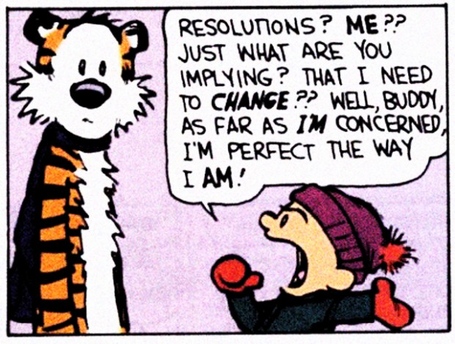
It’s a new year. Here are ten resolutions that every
organization should make to improve their communications in 2013.
- Google yourself. What are the first things people see about you? Would you support the group you see on screen?
Tuesday, November 3, 2009
Don't Get Fooled Again
Part of my schoolwork in the late 1960s was to make myself immune from media bias. I distinctly remember doing a report about the various ways to slant a news story. I turned the assignment into a set of "Wanted" posters, with descriptions of each technique for manipulating minds. The teacher thought it was very creative, but looking back, I believe I was simply reflecting the attitude of the time. People much older than me were reading Marshall McLuhan and Vance Packard and worrying about "the hidden persuaders." Our minds were under attack, and the enemies were in the advertising industry.
Soon, government got caught spinning the news as well. Instead of a "missile gap" between the U.S. and the Soviet Union (itself a storyline that fit the interests of the Kennedy campaign and the military industries but essentially propaganda), we were talking about a "credibility gap" between what the Johnson administration was saying about the Vietnam War and what the cameras were showing on the evening news. A few years later, the Nixon election campaign concerted its advertising in a way that would be immortalized in The Selling of the President 1968, and then the Nixon administration revealed its own mendacity with the press secretary having to tell reporters, "This is the operative statement. The others are inoperative."
I wonder how the schools I attended knew I would need the skills of media criticism--how democracy would need those skills to be shared broadly among the voting public. A recent article by In These Times senior editor David Sirota says those educators had witnessed a revolution in advertising epitomized by the current TV hit Mad Men, and, he implies, they decided to fight back. But Sirota says we are now in the midst of a new assault. The technique is not the advertising jingle, the purveyance of half-truths, or even the hip use of irony. Now, we are being manipulated by what he calls "outraged denial."
No, of course universal health care is not a viable option. You say different? Socialist!
No, of course Iraq was not a distraction and a terrible waste of money. You say different? Traitor!
No, of course the U.S. never tortures people. Pay no attention to that man beneath the curtain, getting electric shocks to his genitals. It was "enhanced interrogation," not torture, and it saved lives--never mind where or how, that is secret.
The idea is that if people just lie and deny, it will take us the public aback. Surely, we will say, they couldn’t be that cynical. They could never put on those faces of injured innocence and lie to our faces.
Except they have. They still do.
No, of course, the withdrawal of the opposition candidate
Don't get fooled again!
Soon, government got caught spinning the news as well. Instead of a "missile gap" between the U.S. and the Soviet Union (itself a storyline that fit the interests of the Kennedy campaign and the military industries but essentially propaganda), we were talking about a "credibility gap" between what the Johnson administration was saying about the Vietnam War and what the cameras were showing on the evening news. A few years later, the Nixon election campaign concerted its advertising in a way that would be immortalized in The Selling of the President 1968, and then the Nixon administration revealed its own mendacity with the press secretary having to tell reporters, "This is the operative statement. The others are inoperative."
I wonder how the schools I attended knew I would need the skills of media criticism--how democracy would need those skills to be shared broadly among the voting public. A recent article by In These Times senior editor David Sirota says those educators had witnessed a revolution in advertising epitomized by the current TV hit Mad Men, and, he implies, they decided to fight back. But Sirota says we are now in the midst of a new assault. The technique is not the advertising jingle, the purveyance of half-truths, or even the hip use of irony. Now, we are being manipulated by what he calls "outraged denial."
No, of course universal health care is not a viable option. You say different? Socialist!
No, of course Iraq was not a distraction and a terrible waste of money. You say different? Traitor!
No, of course the U.S. never tortures people. Pay no attention to that man beneath the curtain, getting electric shocks to his genitals. It was "enhanced interrogation," not torture, and it saved lives--never mind where or how, that is secret.
The idea is that if people just lie and deny, it will take us the public aback. Surely, we will say, they couldn’t be that cynical. They could never put on those faces of injured innocence and lie to our faces.
Except they have. They still do.
No, of course, the withdrawal of the opposition candidate
Don't get fooled again!
Subscribe to:
Posts (Atom)

