Thursday, June 23, 2022

Common Errors Made about Early Judaism

If you are either Christian or Jewish (or have been influenced by people who are), then you should read The Jewish Annotated New Testament. If you can't spare the time to read the whole book, then read the essays at the end. 

And if you can't read all the essays, for God's sake read "Bearing False Witness: Common Errors Made about Early Judaism," by co-editor Amy-Jill Levine.

Levine is an Orthodox Jewish woman who has devoted her scholarly career to studying Jesus and Christianity. Her earlier book The Misunderstood Jew: The Church and the Scandal of the Jewish Jesus is a classic in the field. In other words, she knows whereof she speaks!

Here are ten misconceptions that Levine thinks both Jews and especially Christians have about Judaism circa the time of Jesus. They are not just trivial errors: they make it impossible to understand either Christianity or Judaism in context.


1. The contrast between Jewish "law" and Christian "grace" (and the belief that the "law" is impossible to fulfill). "In actuality," Levine points out, "Jews, then and now, did not find Torah observance any more burdensome than citizens in most countries find their country's law today."

2. The mistaken view of Judaism as religion of "works righteousness." Some Christians believe "Jews follow Torah in order to earn God's love or a place in heaven." But God's love is a given, a place in heaven is not a major Jewish concern, and that is not why Jews use Torah to guide their lives.

3. The erroneous idea that ritual purity laws were burdensome (see #1) and unjust. To Levine, this assumption makes a lot of Christian readings of the Good Samaritan and of Jesus healing a woman from hemorrhages go completely astray. By misunderstanding ritual purity and impurity, they miss the point of their own stories.

4. Related to #3, the idea that Jewish society at the time was uniquely misognynistic. Levine is a feminist, and she says that's nonsense. "Jewish women owned their own homes...served as patrons...appeared in the Temple... and in synagogues, had use of their own property...had freedom of travel...appear in public; and so on."

5. The counterfactual idea that Judaism permitted easy divorce, at the expense of women, when the marriage contract (ketubah) guarantees her right in the case of divorce, and guarantees them in advance.

6. Viewing sinners and tax collectors as "marginal" and "cast out" instead of as what they were: "people who violate the welfare of the community and who have deliberately removed themselves from the common good."

7. Ignoring Jesus' militant statements and Judaism's varied views of the messiah, from warrior-king to shepherd, in order to pretend Jesus was a pacifist and Jews rejected him for that reason.

8. The idea that Jews worshiped a distant, impersonal and completely transcendent God. Where, she implicitly asks, do you think Jesus got the idea that God is abba, Father?

9. The idea that the Temple hierarchy dominated and oppressed the population--when the Temple had more and more become the center of Jewish life in the Holy Land, and Jews loved going there.

10. The false dichotomy of exclusivism vs. universalism. Again, go back to the Tanach, the Hebrew Bible, if you want to find the roots of universalism as a messianic ideal--and study what the texts actually say about interactions between Jews and Gentiles if you want to know what was going on at the time. When anyone states, as in Acts 10, that association between the two is against some law, they are blatantly misstating the historical truth.

Read Levine's essay for yourself and follow her references back to the sources to learn more.


Monday, May 30, 2022

What Christians Ask Me about Leviticus


In the yearly cycle of reading the Torah, Jews all over the world have just finished reading Vayikra, the middle book of the Five Books, known in the English-speaking world as Leviticus. Over the years, online, Christians and those raised in a Christian culture have posed a lot of questions about this book, often the same questions over and over. As a public service, let me post some answers.

What's a Levite?

Levi was one of the twelve sons of Jacob. Since Jacob was given the additional name Israel by God, the descendants of those twelve sons are called "the Children of Israel" or "Israelites." Each had many descendants, and they became the twelve tribes of Israel. (This is the same family that was earlier called Hebrews and that would later be called Jews. Levites are Jews.)

Why were the Levites special?

In the Torah, the tribe of Levi was put in charge of the portable sanctuary, the Mishkan. Specific families within the tribe had responsibility for different tasks involved in its upkeep (when it was in one place) and in its transportation (when the Israelites were on the move, a/k/a "wandering in the wilderness"). Later, when a stationary Temple was built in Jerusalem, they served there.

What's the difference between a priest and a Levite?

All priests were Levites, but most Levites were temple attendants, not priests. Kohanim, the word we translate as "priest," means Aaron (the brother of Moses and Miriam), his sons, and their descendants. Obviously, they were all member of the tribe of Levi, and the rest of the Levites were their cousins. (Please note that a kohen was not like a Catholic priest: not celibate, not empowered to act on God's behalf, not involved in confession. The kohanim were specialists in sacrificial offerings and in keeping themselves in a state of ritual purity so they could properly make those offerings,)

Why is there a book called Leviticus?

Good question! In Jewish circles, it is called after the first word of the book, Vayikra, "and God called." That's the way all the books of the Torah are named. For instance, Exodus is called Sh'mot, "names," because it begins "These are the names...." (It would be silly to have a book called These!)

English-speakers usually call it Leviticus, from the Latin word that means "Levite stuff." A lot--but by no means all--of the book is instructions to the priest and Levites about how to do their jobs.

Are there still priests and Levites in Judaism today?

Yes, but they do not perform the same function as they used to.

Since the Second Temple was destroyed by the Roman Empire in the year 70 CE, it has been impossible for priests and Levites to maintain a nonexistent building or to offer sacrifices there, and they are not allowed to do it anywhere else. Some Jews fervently hope for the day when the Temple will be rebuilt and the system of sacrifices will be restored. Others would rather not see it happen, because:

  1. One of the holiest sites in Islam now occupies part of the Temple Mount, and destroying it would be a terrible thing (and probably lead to war).
  2. We don't see any reason for all those cattle, sheep, goats, and birds to get killed in order to praise God.
  3. Both of the above.

In many synagogues today, if a kohen is present he (or, in more liberal synagogues, she) will be the first one called up to the Torah during the service. A Levi will be the second one of the seven called up on Shabbat. This is a vestigial reminder of the roles they used to play.

If the Temple is destroyed and the priests and Levites can't offer sacrifices on our behalf, does that mean that all Jews are damned?

No! This is a complete misunderstanding and a self-serving fiction by Christians trying to claim that they have taken the place of Jews. Damnation is not a concept in Judaism. We do not have to be perfect to be loved by God. And animal sacrifices were never the only way to ask God for forgiveness. Already in biblical times, the prophet Hosea wrote:

Take with you words, and come back to the Lord; say to him, Let there be forgiveness for all wrongdoing, so that we may take what is good, and give in payment the fruit of our lips. https://www.biblestudytools.com/hosea/14-2-compare.html

For the last 2000 years or so, we have had synagogue services that exactly correspond to the daily offerings in the Temple: evening, morning, afternoon, and additional offerings on Shabbat and holidays. That is to remind us (and perhaps, depending on your theology, God) that we continue our relationship with God under changed conditions.

So why should anyone study Leviticus today?

Well, I could hedge and say that there is a lot of content in the book that is not a technical manual for Levites. There are laws about social justice, like leaving the corners of your field for the poor and dispossessed to harvest by right, not charity. There is a holiday calendar. There are the basic laws of kashrut, the Jewish dietary laws. (The much-maligned Pharisees, who democratized the idea of holiness so that it didn't apply only to priests and Levites, elaborated on these laws so that the ordinary act of eating a meal could be like offering a daily sacrifice in the Temple.)

But let me say this straight out: it's worth studying Leviticus for its own sake. 

Simply reading it might not be worthwhile. Too many things are puzzling, meaningless, or abhorrent on first glance when we approach the text with a twenty-first century mindset and in the absence of deep, searching commentary. Fortunately, there's a two-thousand-year tradition of wrestling with the text, and when we become part of that tradition (and you don't have to be Jewish to do so!), we gain historical, political, ethical, and spiritual insights that might or might not be available elsewhere.

I am looking forward to reading Avivah Gottlieb Zornberg's new commentary, https://www.goodreads.com/book/show/58537835-the-hidden-order-of-intimacy.

Sunday, October 24, 2021

From Text to Tradition: A History of Second Temple & Rabbinic Judaism (Lawrence Schiffman)

According to Jewish legend, the First Temple in Jerusalem was destroyed in 586 BCE and the Second Temple in 70 CE, on the same day of the Jewish calendar. 

We Jews mark that day, Tisha B'av, every year, in memory of the two destructions, as if nothing happened in between. 

That elision is certainly consistent with how I learned Jewish history. In my education, there was a big blank between the return from the Babylonian Exile and the conquest of Jerusalem by the Roman general Titus. 

Only the Maccabean revolt was stuck in the middle (the way Chanukah is stuck in the middle between the fall holidays and Pesach in the spring).

For someone like me, then, From Text to Tradition : A History of Second Temple and Rabbinic Judaism does a great service.

I picked up this book while I was taking part in a 929 daily discussion of the Tanach. We had reached the biblical books of Ezra and Nehemiah, and I was confused. Who were these people, and how did they relate to some of the figures I'd read about earlier in Zechariah (Zerubabel and Joshua ben Jehozadak)? Who were the Jews who never went into Babylonia? What were people from other countries doing in Judea now? And who were the Samaritans, and why was there (what seemed like) sibling rivalry between them and the Jewish leaders?

Schiffman clarifies many of these points and makes me want to learn even more about them. He goes on to talk about Jewish life during the age of Alexander the Great and his successors, especially the Ptolemies in Egypt and the Seleucids in Syria, not only in the holy land but all around the Middle East. In Judea itself, he briefly addresses the conflicts between high priests and Hasmonean monarchs (descendants of the Maccabees)--and among the members of the royal family themselves. 

An aside: Why, I wonder, have there not been as many novels about the Hasmoneans as about the Tudors, or the Medici? The rivalry in the court of Salome Alexandra is certainly as dramatic as the politics under Elizabeth I. There is fertile ground here for fiction writers!

Schiffman purports to be writing a history of Judaism, not Jews, during this period. Repeatedly, however, he makes the point that you cannot understand how Jewish thought and practice evolved without paying attention to the social and political pressures that shaped it. 

This seems especially true for the period just before the destruction of the Second Temple. Knowing what was going on between different "political parties" in Judea and their relations to Hellenism, to Roman rule, and to nations fighting against Rome (like the Parthians) is vital to understanding Jewish sects like the Sadducees, Pharisees, Essenes, the people at Qumran, and the Jesus-followers who eventually became a separate religion.

There are some texts that were written by Jews that have played a more important part in Christianity and in historiography than in Judaism. These include the Septuagint, the apocrypha, the pseudepigrapha, the philosophy of Philo Judaeus, and the history written by Josephus. Schiffman explains that the Greek-speaking Jews of the diaspora might at one time have been familiar with these, but they increasingly were absorbed either into the Greek-speaking Christian world or into the Hebrew-speaking, Palestine-centered Jewish sphere. 

Then he goes on to explain the texts that did become central to rabbinic Judaism (which with very few exceptions is Judaism as we know it today): the Mishnah, the baraita, the Palestinian and Babylonian Talmuds, the books of midrash.

Whew! I see I cannot discuss this book without doing a lot of name-dropping. If you are not at all familiar with this history, perhaps Schiffman is not the best one to introduce you to it. 

If you're in a similar place as I am however--very familiar with some of these people, places, and things and only vaguely familiar with others--then he may be a good teacher to put them together into a more complete picture.

I note, however, that this book was published thirty years ago, and the author was already hoping that recent discoveries and studies would fill out the picture more. If you know of a more up-to-date book that compares to this, would you please suggest it to me?

Monday, July 5, 2021

Jewish Holy Day Calendar, 2021-22


Here's a guide to scheduling around the Jewish holy days that I thought you might find useful.   I didn't write it, only edited it slightly and updated it each year, but I vouch for its accuracy.

Category I.     MOST JEWS PARTICIPATE.  Please do not schedule meetings around these dates.

ROSH HASHANAH (Jewish New Year) begins at sunset Monday, September 6, 2021 and continues through Wednesday, September 8.

YOM KIPPUR (Day of Repentance) begins at sunset on Wednesday, September 15, 2021 and continues through Thursday, September 16.  While Yom Kippur is a fasting day, meals are prepared in advance for the breaking of the fast at the end of 27 hours.

Typically, even some of the least religiously observant members of the Jewish community do not work on Yom Kippur or Rosh Hashanah.   Please keep in mind that even though the holy day may begin at sunset, these are home ritual centered holy days, so a great deal of advance preparation is required.  In other words, please don't schedule a meeting for the afternoon preceding the holiday because I will be cooking!

PASSOVER (Celebration of Freedom from Slavery in Egypt) begins at sunset
on Friday, April 15, 2022; continues through nightfall on Saturday, April 23.   THE FIRST TWO DAYS (through Sunday evening, April 17, 2022) require refraining from work.    LOTS of cooking and preparation before this holy day.

---------------
Category II.   Many observant Jews refrain from work.  I count myself as observant.

SUKKOT (Festival of Booths, or Tabernacles) begins at sunset Monday, September 20, 2021 and lasts through Monday, September 27.  THE FIRST TWO DAYS (through Wednesday, September 22, 2021) traditionally require abstaining from work.


SHMINI ATZERET (Eighth Day Assembly, ending Sukkot) begins at sunset on Monday, September 27, 2021 and lasts through Tuesday, September 28.


SIMCHAT TORAH (Rejoicing with the Torah) begins at sunset on Tuesday, September 28, 2021 and lasts through Wednesday, September 29.

The LAST TWO DAYS of PASSOVER begin at sunset Thursday, April 21, 2022 and last through Saturday, April 23.

SHAVUOT (Festival of Weeks, or Pentecost to our Christian friends) begins at sunset on Saturday, June 4, 2022 and continues through Monday, June 6


TISHA B’AV (fast day marking the destruction of the ancient Temple in Jerusalem) begins at sunset on Saturday night, August 6, 2022 and continues through Sunday, August 7.


-----------------
Category III. Observance doesn't require refraining from work.


HANUKKAH
(Festival of Lights) begins at sunset on Sunday, November 28, 2021 and
continues through nightfall Monday, December 6.  Every night, candles on the
Hanukkiah (eight-armed candelabra, sometimes called "menorah") are lit.

PURIM - Begins at sunset on Wednesday, March 16, 2022; continues through Thursday, March 17.


And a few other seasonal and historical holy days that I won't mention, because enough already!  If you want to know more about the meaning of these holidays, you might consult
www.jewfaq.org or the book Seasons of Our Joy, by Arthur Waskow.

[Dennis] A final note which I thought worth adding from my own experience: Even if someone (who might be Jewish) tells you "It's no big deal" to schedule meetings and
conferences on these days, doesn't mean that that's true for all Jews.   People maintain different levels of observance, and a more secular Jew may work on a day when I would not. 


When in doubt, please ask!  I can't speak for other Jewish consultants, staff, board members, and interns, but I know I always prefer to be asked.

Thank you!

Thursday, March 11, 2021

Arguing with God is Sacred (Parshat VaYakhel-Pekudei)

In this week's parshah, the first one I ever chanted from the Torah scroll, there are two very different ideas about our dialogue with God. The first: that there are things we cannot figure out for ourselves and can only learn through being divinely inspired. The second: that we have some things to teach God, too.

God Teaches Us 


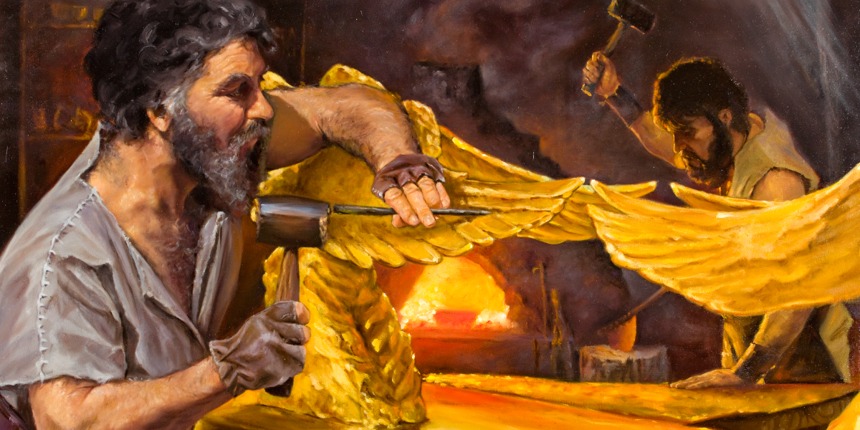
"And Moses said to the Israelites: See, the Lord has singled out by name Bezalel, son of Uri son of Hur, of the tribe of Judah. He has endowed him with a divine spirit of skill, ability, and knowledge in every kind of designer's craft...." (Exodus 35: 30-31)

According to Avivah Zornberg, drawing on Rashi's commentary, the Hebrew words used here for "skill" (or "wisdom") and "ability" (or "understanding") are qualities a human being can possess innately or can learn. The word da'at, here translated as "knowledge," goes beyond that. It is an intimate kind of knowledge: in her words (p. 470), "the mystery of a gift that can be explained in no other way than as 'taught by God.'"

So, when Moses says that God has given da'at to Bezalel, it goes beyond conferring legitimacy on Bezalel's direction of the project of building the Mishkan (and let us not forget his assistant, Oholiav, because the #2 is often the person who makes everything work!). Moses allays the people's remaining fear that a building project--like the Golden Calf--that is not supervised moment to moment by Moses himself can lead them away from God, toward plague and death. 

On this, first, reading, human initiatives can be dangerous, and only a "divine spirit" can lead us in the right direction. Our job is to listen.

We (or at least, Moses) Have Something to Teach Too

The link between the Golden Calf and the Mishkan has been implicit throughout the later chapters of Exodus. The midrashic commentary makes the link explicit. 

One commentator marvels that the Israelites can be so generous both for a misguided effort and for a well-guided one. For the building of the Golden Calf, they tore off their gold earrings, and for the Mishkan, they brought so much gold and other gifts that Moses had to call the capital campaign to an end! (Exodus 36:4-7) "The Holy One, Blessed be God then said: 'Let the gold of the Mishkan atone for the gold they brought toward the making of the Golden Calf." (Shemot Rabbah 51: 6)

But did God reach this conclusion by God's self, or did God have a little help? In the midrashic literature, Moses makes a sly argument to drive God toward a position of forgiveness. I quote:

"R. Nehemiah said: When the Israelites committed that sin, Moses began to appease God. He said: 'Master of the universe, they have provided you with help, and You are angry with them! this calf that they have made will help you: You will make the sun rise and it will take care of the moon; You will bring forth the stars and it the planets...'

God answered: 'Moses! Are you, too misled like them! For there is nothing in the idol!' And Moses replied: 'If so, why are you angry with Your children?'"

Moses is saying to God, in effect--what do you have to complain about? We all know the Calf has no power. Given that, what is there to be jealous of?

It is with arguments like these--teasing, cajoling, intimate--that Moses time and again wins God's forgiveness for the people. And Moses is standing in the footsteps of the first father of the Jewish people, Abraham, who tries to save even the people of Sodom and Gomorrah by arguing with God on their behalf. His ultimate failure doesn't take away from the greatness of his example.

On this alternative reading, it would be folly, wickedness, a dereliction of duty for Jews to accept God's instructions passively. As Rabbi Abraham Joshua Heschel wrote, God is "in search of Man." God seeks the active partnership of humanity in repairing and perfecting the world. If we make it worse through some of our actions, that is no excuse for not striving to make it better.

With our hands and our craft, or with our hearts and our words, we build the sacred in our lives.

---------------------------------------------------------------------------

I've been reading through Avivah Gottlieb Zornberg's amazing commentary on the biblical Book of Exodus, The Particulars of Rapture. Each chapter expounds one of the portions we read in the synagogue weekly. It's slow going because it is so rich with insights, and I cannot begin to do it justice. To keep on track, I have been posting at least one insight weekly for the last ten weeks, and (thanks to God and my study partners) I have now finished the book.  If these reflections have been interesting to you, my blog reader, so much the better!